The AI tutor for dental assistants
Become a FourHanded dental assistant.
Chairside answers and exam prep in one place. Ask Cara what you'd ask a great lead assistant.
10 free questions, no card required.
Run a dental office? See how Cara learns yours. FourHanded
A hemostat is a locking clamp with finger rings and slim serrated jaws. Most offices use the curved one.
It grasps small objects and tissue, retrieves a dropped crown or a broken bur, and clamps a small bleeding vessel. To pass it, close it on the first ratchet click, hold it near the jaws, and place the rings into the doctor's palm, tips toward the tooth.
See Cara in action
Real questions, real answers, exactly as they look in the app.
Tell her once how you learn, and she teaches that way from then on.
Here's the diagram, with the nerves replaced by letters.
Question 1: What is the nerve labeled A?
Here's A again, DANB style.
Which nerve is labeled A on the diagram?
A. Anterior superior alveolar
B. Posterior superior alveolar
C. Middle superior alveolar
D. Inferior alveolar
Correct. A is the posterior superior alveolar nerve, which supplies the maxillary molars (and the surrounding gingiva and bone). The tempting wrong answers: the middle superior alveolar covers the premolars, the anterior superior alveolar covers the canine and incisors, and the inferior alveolar is on the mandible, not the maxilla.
DANB-style questions, one or a whole set, each with the why explained.
Here's one in DANB style:
Which of the following is the main purpose of collimation in dental radiography?
A. To remove low-energy x-rays from the beam
B. To restrict the size and shape of the x-ray beam
C. To increase the penetrating power of the beam
D. To reduce the time the patient is exposed
Take your pick and I'll tell you how you did.
Correct. Collimation restricts the size and shape of the x-ray beam, usually with a lead diaphragm in the tubehead (or a rectangular PID, which narrows the beam to roughly the size of the receptor). A smaller beam means less tissue irradiated and less scatter, which is ALARA in action.
The tempting wrong answers each describe something else:
- A is filtration. An aluminum filter removes the low-energy, long-wavelength x-rays that add patient dose without helping the image.
- C describes kilovoltage peak (kVp). Higher kVp means shorter wavelength and more penetrating power.
- D is exposure time, set on the control panel. Collimation doesn't change how long the beam is on.
What the doctor meant, what goes on the tray and how to set it up.
You've got this. First, #30 is the lower right first molar, the patient's right, so that's the side you're working on. Receptor in the bite block, arm into the block, ring onto the arm. Last look before it goes in the mouth: sight through the ring, down the arm, and the sensor should sit centered in the ring. Block on the lingual of #30, patient closes gently, ring in to the cheek, PID flush with the ring. Step out, expose, done.
The ring does the geometry for you. That's the paralleling technique: receptor parallel to the long axis of the tooth, beam perpendicular to both. If the image comes out stretched or squashed, the receptor wasn't parallel to the tooth. Want me to walk you through the bitewing too?
She knows when the right answer is "stop and tell the doctor."
Stop and tell the doctor before anything else happens. This is a "pause and report" moment, not something to work around.
Hold off on setting up or seating for the extraction until the doctor knows. Step out of the patient's earshot or quietly say, "Doctor, can I grab you for a second?" Patient-facing words stay neutral: "The doctor will be right with you."
What the doctor will probably want to know:
- Which medication and the dose
- Why they take it and who prescribes it
- When they last took it
- Their most recent INR, if they're on warfarin
You gather and record; the doctor decides what happens next. Never advise the patient to stop or skip a dose.
Chart it: update the medical history with what the patient told you, and take vitals if that's your office routine.
A name you don't know, or one you can't place? Ask, or send a photo.
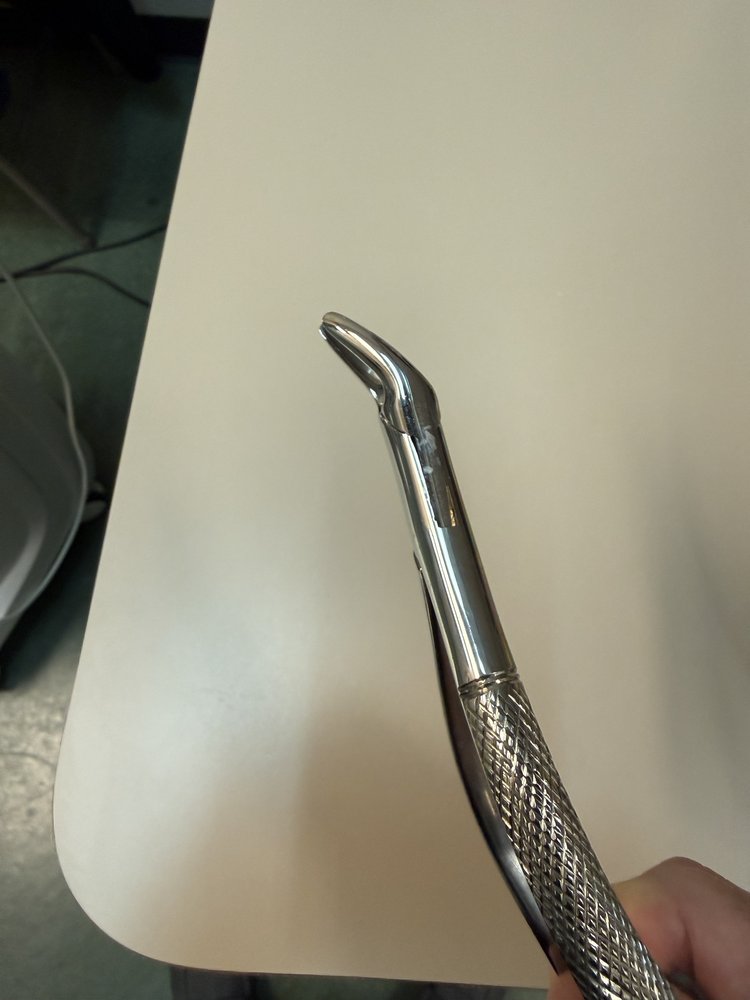
Probably not, and it looks more like a 150 (upper universal) to me.
The beaks here run fairly in line with the handle, with only a slight bend at the tip. A 151 has its beaks bent sharply down toward the handles.
To settle it for sure, check the number stamped on the handle, or take a closer look at the working end next to the pictures above. If it says 150, grab the 151 instead, since the doctor asked for a lower tooth forceps. If you can't find a 151, or the stamp is worn off, ask the doctor before passing anything.
Give her your office's documents and she answers your way.
From Main Street Dental's Office policies:
More than 15 minutes late, check with the front desk before seating. If the schedule can't absorb it, the front desk reschedules. Let the doctor know either way.
An example from the Office plan. Cara answers from what your office adds.
Who FourHanded is for
Works alongside whatever you already use: your office protocols, your school's curriculum, your DANB prep book.
Preparing for a DANB exam
Practice for the RHS, ICE and GC with questions written the way the exam asks them, and a tutor who notices what you missed and helps you learn it.
Learning on the job
Instrument names, tray setups, and what the doctor meant by that word, all before the patient's numb.
Training your team
Add your own tray setups and protocols, and Cara teaches new assistants the way your office does it. One subscription for the whole team.
Dental assisting school
For students and the people teaching them: a tutor who knows the material, the DANB outlines, and answers at 10 pm the night before the test.
What Cara knows
- The whole job. Learning material that covers all of it: chairside procedures, instruments, materials, radiography, infection control, anatomy, charting and more.
- The DANB, the way it's tested. The RHS, ICE and GC outlines, how each exam weights its topics, and the kinds of questions that show up on test day.
- The rules behind the rules. CDC, OSHA, the ADA's radiography recommendations, and what DANB publishes about its exams.
- The why, not just the what. Why the alginate tore, why the contact overlapped, why that step can't be skipped.
- Pictures, both ways. Send her a photo of an instrument or a tray and she tells you what it is. Ask about an instrument and she shows you a picture.
For dental offices
Cara knows dental assisting. Now she knows your office too.
Customize Cara with your protocols, policies, tray setups, doctor preferences and onboarding documents. She answers your way and says which sheet it came from.
- Easy setup. Add your PDFs, Word files and typed notes, then share a link or code with the team.
- Faster onboarding. A new hire learns how your office does it from day one and asks Cara first, so your lead assistant stays chairside.
- Answers in seconds. Anyone on the team can ask about a policy or a setup and get your office's answer, instead of digging through a binder.
Included in the Office plan: $14.99 your first month, then $29.99 a month for the whole team.
FourHandedMain Street DentalFrom Main Street Dental's Crown prep tray sheet:
- Mirror, explorer, cotton pliers
- Anesthetic syringe and topical
- High-speed handpiece and crown prep burs
- Retraction cord and cord packer
- Scanner set up and ready
- Impression tray and material
- Temporary crown material and cement
The sheet also notes that Dr. Lee wants the shade taken first, before the tooth dries out.
An example. Cara answers from what your office adds.
Plans
Every plan includes chairside answers, DANB prep, instrument identification and a tutor who remembers how you learn.
Launch offer: 50% off your first month of Individual or Office, automatically applied at checkout.
For assistants
Individual
Most popular$9.99$4.99/month
50% off first month
Renews at $9.99/month after your first month. Cancel anytime.
For one person: a student, a new hire, or a working assistant.
150 questions a month
Start with IndividualExam Pass
90 days, no subscription$24.99one time
One payment, 90 days of access.
Same Cara, paid once: three months for the push to the exam.
500 questions, cram them or spread them out
Get the Exam PassFor offices
Office
Whole team, one bill$29.99$14.99/month
50% off first month
Renews at $29.99/month after your first month. Cancel anytime.
One plan for the whole office, however many assistants are on the team. Add your onboarding documents and office policies, and Cara teaches every new hire your way.
How it works
- 1Subscribe and name your office.
- 2Customize Cara with your tray setups, protocols and what each doctor likes.
- 3Share a link or code. Each assistant signs up with their own email.
- 4The team shares 400 questions a month.
Not sure yet? Try FourHanded free: 10 questions, no card required.
On a plan and run out? Add 100 questions any time for $5.99; they never expire and work with any active plan.
Questions people ask
Why not just use ChatGPT?
ChatGPT is a generalist. Cara is built for this one job. She answers from the standards that govern the op (CDC, OSHA, ADA, AAOMR), DANB's own exam outlines, and dental assisting learning material that covers the whole job, so what you learn from her holds up on the exam and in the chair. She knows scope of practice depends on your state, quizzes you with DANB-style questions, and reads a photo of an instrument or a tray. When an answer gets flagged, dentists review it and correct her material as needed.
What can I try for free?
Every new account gets 10 questions free, no card required, on anything you want to ask. After that, pick the plan that fits.
What counts as a question?
Each message you send Cara is one question, including quiz answers and follow-ups. A photo or a spoken answer counts the same as any other question; dictating a question is free. Asking her to check the web counts as two. Monthly questions reset each billing month and don't roll over. The Exam Pass starts the day you buy it, and its 500 questions are one pool to use any time in the 90 days. Top-up questions never expire, but they only work while a plan is active.
Will she help me pass the DANB?
She quizzes you with DANB-style questions across the RHS, ICE and GC outlines, one at a time or as a full set, and explains why each answer is right or wrong. Ask her to quiz you on a topic you keep missing and she'll stay on it. She can't certify you, but she'll help you understand what the exam is testing.
Where do her answers come from?
Published standards from the CDC, OSHA, the ADA and AAOMR, DANB's exam outlines, dental assisting learning material covering the whole job, and a broad working knowledge of dentistry for the questions that don't come out of a textbook.
How does the Office plan work?
The owner subscribes and customizes Cara with the office's own setups and protocols, then shares a link or code. Each assistant signs up with their own email. Everyone shares the office's 400 questions a month.
Can Cara learn how our office does things?
Yes, on the Office plan. The owner adds the office's tray setups, protocols and doctor preferences as typed notes or as PDFs and Word files (up to 15 files). When anyone on the team asks how something is done here, Cara answers from those and says which one it came from. If a sheet ever conflicts with a CDC or OSHA standard, she teaches the standard and suggests checking with the doctor.
Who can see and change our office's documents?
Only the office owner can add or remove them. To update one, remove the old version and add the new one. Everyone on your plan can see the list of what's loaded, gets answers from it, and can open a document to check an answer against it. Nobody outside your office can see them, and they are never used to train AI.
What if our documents don't cover a question?
Cara tells you your office's documents don't cover it and gives the general answer from her own material. When they cover part of a question, she uses them for that part and tells you which is which.
Can I cancel?
Any time, from your account page. You keep access until the end of your current billing period.
Can I send photos, and what should I leave out?
Yes: an instrument, a tray, a material, a setup. Leave patients out of it: no names, chart numbers or faces. Photos are read for the answer and never stored.
Is Cara a replacement for school or the DANB?
No. She's the tutor alongside them, and she works with whatever you already use: your program's curriculum, your office's protocols, your prep book. She won't certify you, but she'll help you understand what the exam is testing.
Bring Cara your next question.
10 free questions, no card required.